HeartAI: Heart Rate Game AI
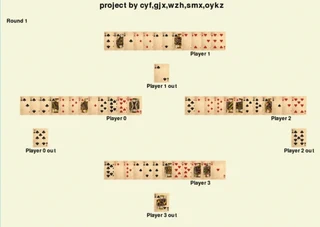 AI agent playing Heart Rate Game
Team
- YiFan Cai (leader)
- JunXian Guo
- ZhiHang Wang
- etc
Overview
This project develops an AI agent for the Hearts card game, a multi-player, imperfect-information environment requiring strategic reasoning and long-term planning. The goal is to compare classical search-based and learning-based decision-making methods under realistic game constraints.
Key Features
-Supports multiple AI paradigms within a unified game engine
-Adaptive MCTS for improved runtime–performance trade-offs
-State abstraction enabling Q-learning in large, discrete action spaces
-Simulation and visualization tools for strategy comparison and analysis
Methods
We implemented and evaluated greedy, Monte Carlo Tree Search (MCTS), and Q-learning agents. MCTS handles uncertainty through randomized rollouts and includes an adaptive variant that reduces computation when the agent is ahead. To enable learning in a large state space, the Q-learning agent uses state abstraction and reward shaping, learning strategic behavior through repeated self-play.
Results
Experiments over simulated games show that MCTS achieves the strongest performance at the cost of higher computation, while the Q-learning agent outperforms greedy and random baselines with improved adaptability. The results highlight trade-offs between decision quality, efficiency, and learning capability in imperfect-information games.
