Building an Intelligent Pac-Man Agent
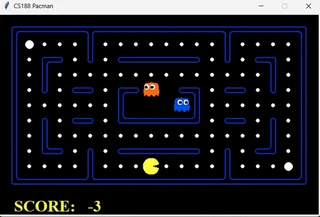 Evolution of Pac-Man intelligence across planning, inference, and learning
Overview
This project series incrementally develops a fully autonomous Pac-Man agent, transforming it from a weak, rule-driven system into an intelligent decision-making agent capable of planning, reasoning under uncertainty, and learning from interaction.
The projects are organized as a coherent progression, each introducing a more advanced AI paradigm.
Logic & Classical Planning
In the initial stage, Pac-Man operates under logic-based representations and classical planning:
- Explicit modeling of world states, actions, constraints, and goals
- Automatic generation of feasible action sequences
- Deterministic planning in fully observable environments
This stage establishes the foundation for symbolic reasoning and goal-directed behavior.
Bayesian Networks
To handle uncertainty, Bayesian networks are introduced:
- Probabilistic modeling of hidden variables
- Inference under noisy or incomplete observations
- Decision-making based on belief states rather than exact knowledge
This enables Pac-Man to reason probabilistically instead of relying on fixed rules.
Ghostbusters: Tracking Under Uncertainty
In the Ghostbusters setting, Pac-Man faces invisible ghosts and noisy sensors:
- Bayesian filtering for belief state updates
- Particle filtering for continuous ghost localization
- Sequential decision-making in partially observable, dynamic environments
This stage bridges probabilistic inference and adversarial game dynamics.
Reinforcement Learning
Finally, the agent transitions to reinforcement learning, removing the need for handcrafted models:
- Learning policies directly from environment interaction
- Optimizing long-term rewards instead of immediate objectives
- Adapting behavior through trial and error
At this stage, Pac-Man becomes a self-improving agent capable of autonomous strategy learning.
