PERoKF: Physics-Enhanced Super-Resolution of Kolmogorov Flow
Dec 19, 2025
·
2 min read
Team
- YiFan Cai
- YiRan Hu
- JiaCheng Zhu
Overview
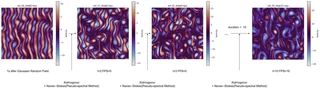
PERoKF studies how to inject physics priors into modern neural networks for single-frame super-resolution of 2D Kolmogorov flow—without requiring temporal supervision. The goal is to recover fine-scale turbulent structures lost by downsampling.
- Input (LR): 128×128 vorticity
- Target (HR): 512×512 vorticity (4×)
Methods
We evaluate four model families (all operating on bicubic-upsampled LR inputs and predicting HR vorticity):
- CNN: lightweight hierarchical convolutional baseline
- UNet: multi-scale ResNet-style UNet (optional attention)
- FNO: Fourier Neural Operator with truncated spectral modes
- Diffusion: conditional DDPM with UNet backbone (x₀-prediction)
Physics-guided strategies
- Physics-derived feature augmentation
- Laplacian, streamfunction, velocity components, nonlinear advection terms
- Physics-consistency loss
- Navier–Stokes residual loss using the same pseudo-spectral operator as data generation
- Enforces consistency via implied time derivatives
Key findings (high-level)
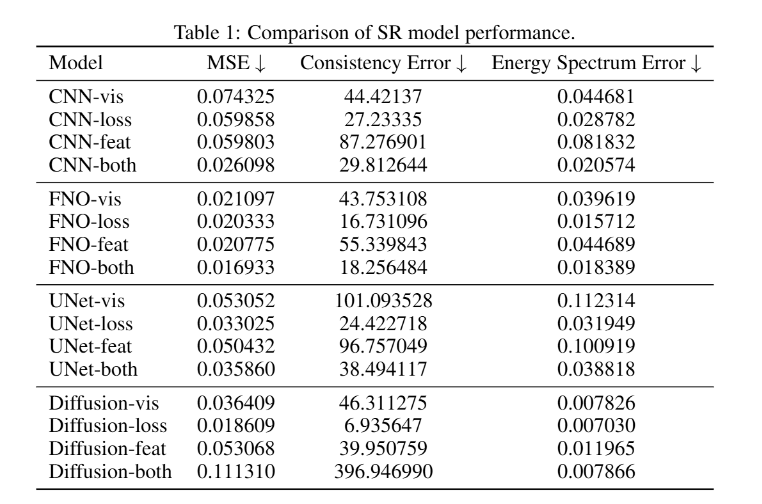
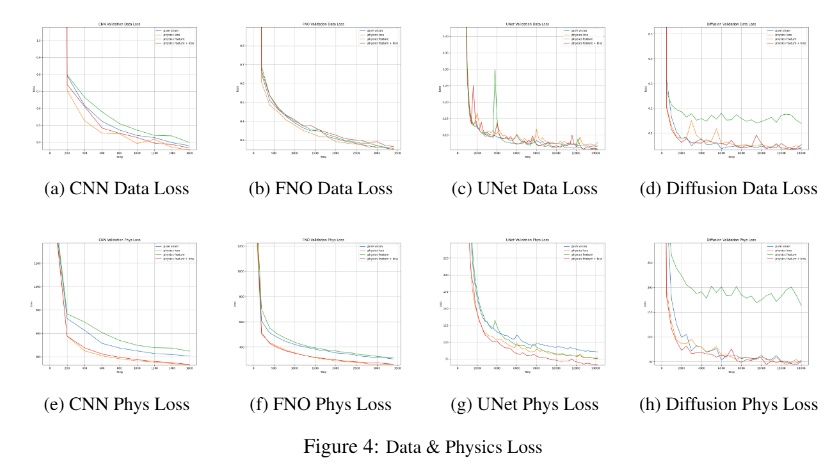
- Physics-consistency loss consistently improves physical accuracy (e.g., lower PDE residual and energy spectrum error) and can accelerate diffusion convergence.
- Physics features alone are not consistently beneficial and may destabilize training.
- Combining both can improve accuracy but may introduce instability under limited compute.
Dataset & evaluation
Dataset: 2D Kolmogorov flow (HR 512×512 / LR 128×128), Reynolds numbers 1000/2000/3000, forcing wavenumbers 8/12/16.
Metrics:
- MSE (pixel reconstruction)
- Physics Consistency Error (PCE)
- Energy Spectrum Error (ESE)
Reproducibility
- Training configs and scripts are included in the repository.
- Visualization scripts compare HR/LR/reconstruction and energy spectra.

Authors
YiFan Cai
(he/him)
Graduate student
I am a graduate student in Systems Engineering at the University of Pennsylvania, with a B.S. in Computer Science from ShanghaiTech University.
I have research experience in diffusion models, computer vision, robotic manipulation, and molecular drug design. My current interests focus on world models, computer vision, and artificial intelligence.